
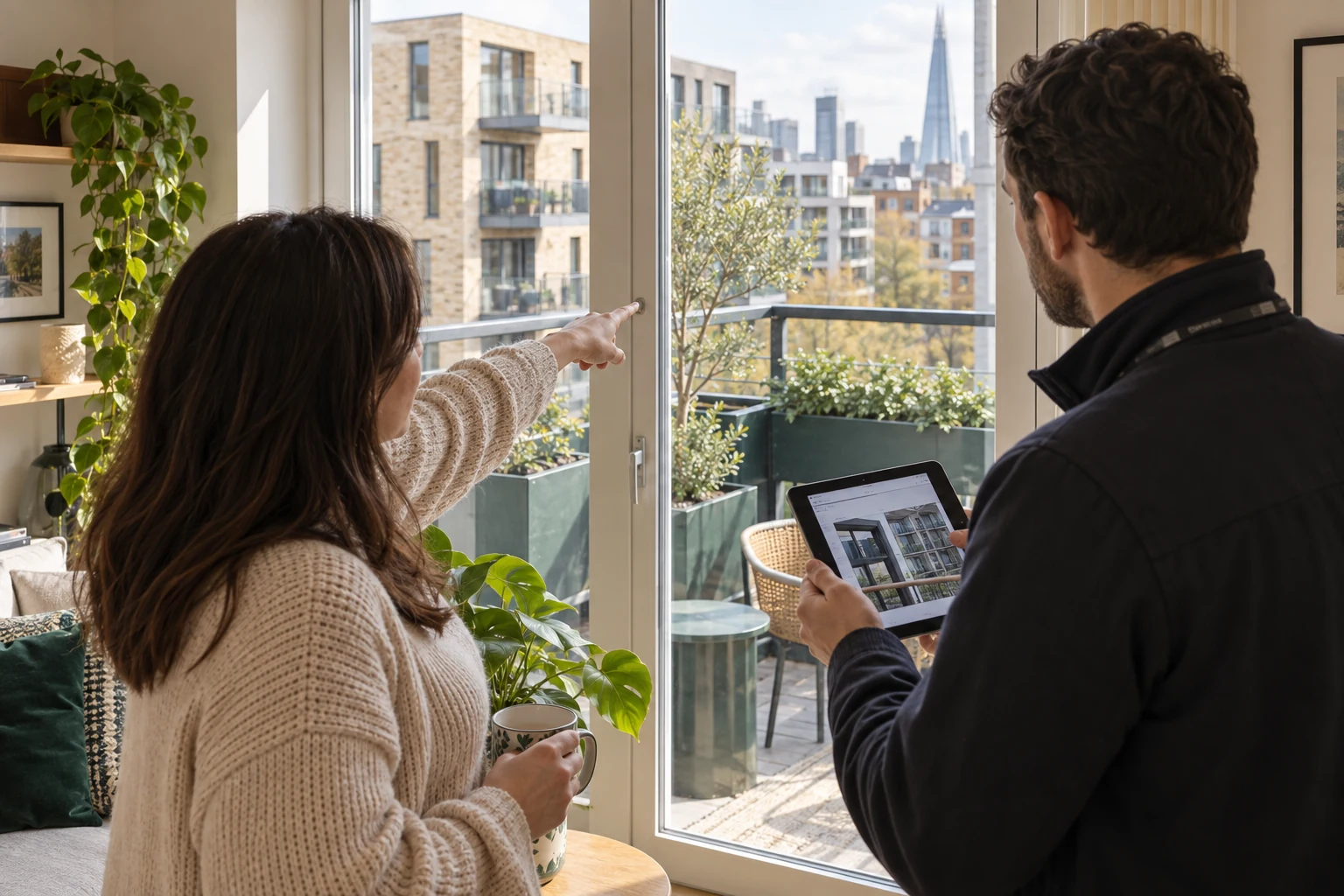
Plan a balcony survey around resident permission, safe indoor access and current bird activity. Ask residents to report where birds land or enter from inside the dwelling; do not ask them to lean out, climb or disturb a nest for photographs.
Map each balcony as a usable space
Record doors, drainage, planters, screens, lights and maintenance access as well as the reported perch or opening. Note whether the balcony is private, shared or reachable only through a home. Photographs from inside should show the whole elevation detail without including neighbours or personal interiors unnecessarily.
Ask about repeated landing, entry into a cavity and nesting material separately. A few birds on a nearby roof do not prove a nest on the balcony. If a nest, eggs or dependent young may be present, stop disturbance and obtain competent advice.
Protect residents and wildlife in the schedule
GOV.UK states that wild-bird nests are protected while being built or used and eggs are protected. There is no universal date on which every balcony is clear; the actual site must be checked before proofing or removal work.
Agree notices, appointments, pets, door access and what happens if a resident is unavailable. Explain whether the visit is observation only or includes cleaning, proofing design or another task. Roof and rope access must be confirmed separately where relevant.
Require a maintainable proposal
Any netting, spike or other deterrent plan should preserve balcony doors, drainage, window cleaning and emergency or maintenance routes. Record inspection access and who responds to damage or a trapped bird. Do not accept a device choice based only on total metres.
Call 0203 393 2338, or read the bird service page.
Frequently asked questions
Can residents remove a nest themselves?
Do not advise disturbance. Active nests and eggs are protected; obtain current competent advice.
Must every balcony be entered?
Survey scope should follow the building geometry and evidence, with permission for each private space.
Is proofing maintenance-free?
No. Access, fixings, drainage and damage need an assigned inspection plan.
Sources and further reading
External references may contain pest or skin photographs.