
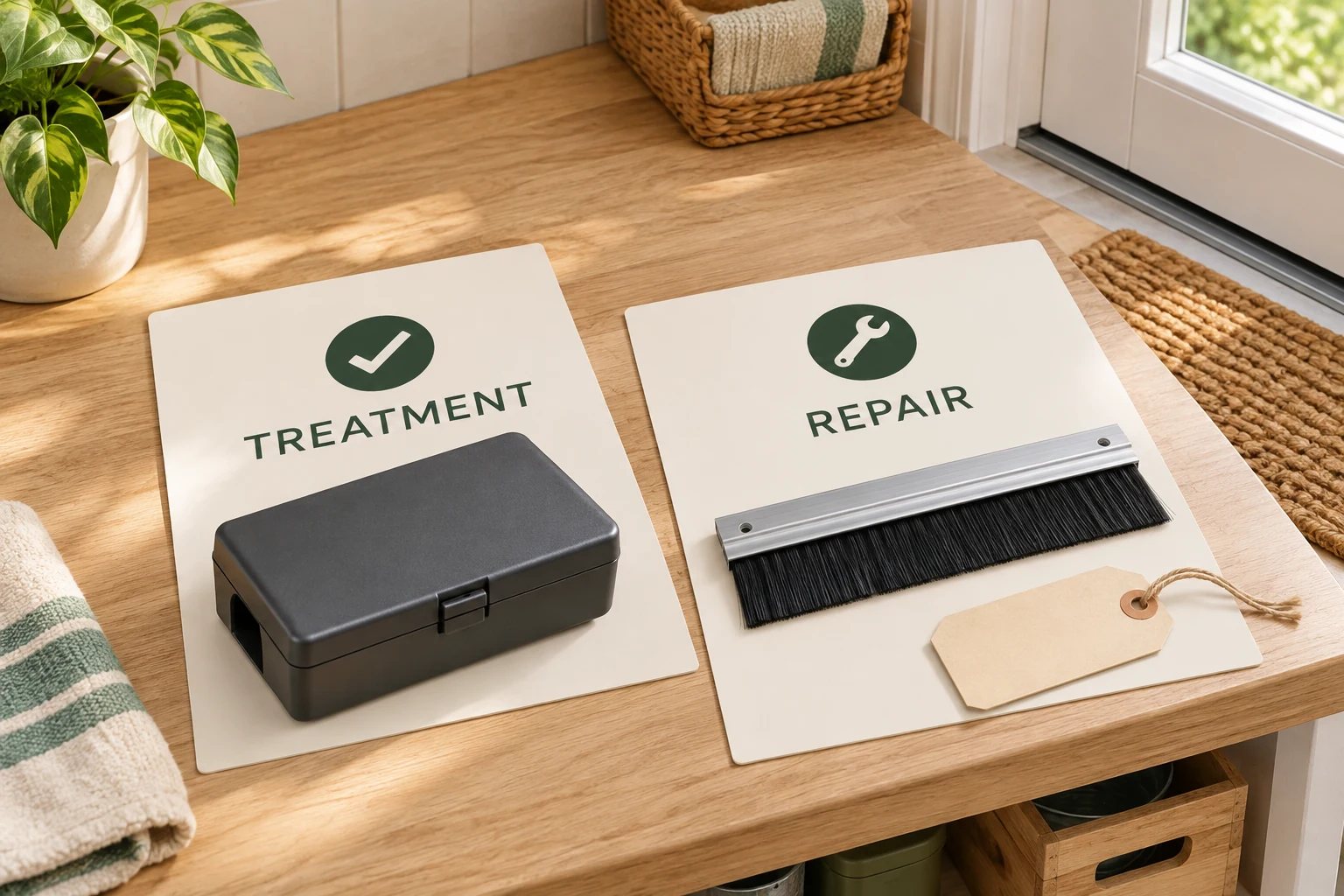
Treatment responds to current pest evidence. Proofing changes an identified route or building feature. Some cases need one, some need both, and the order depends on what the inspection finds. The practical approach is to keep them as separate workstreams with a shared record: what evidence exists, what action is proposed, who completes it and how the result will be checked.
Begin with the decision the evidence supports
A damaged air brick, gap around a pipe or poorly fitting door may deserve repair, but a visible gap is not automatically the route responsible for a particular sign. Equally, placing control equipment does not repair a building defect. Ask the inspector to connect each recommendation to a room, feature and observation.
When identification or extent remains uncertain, monitoring or further access may be the next step. When active evidence is clear, the plan may include control and a timed review. When a building route is confirmed, the plan should state the repair without implying that every possible route has been found.
Write treatment as its own scope
The treatment record should explain the target evidence, areas included, method, visit or review plan, preparation, restrictions and what would cause the approach to change. If a biocidal product is used, HSE says it must be suitable for the intended use and its label followed. The label can govern who may use it, where it is applied and access during or after treatment.
This is why a general phrase such as “spray the room” is insufficient. The method must fit the pest, property and people or animals using the space. Ask what must remain undisturbed and what to report between visits.
Write proofing as a named repair
A proofing item should identify the exact feature, proposed material, access needed, person responsible and completion evidence. “Seal kitchen gaps” leaves too much room for disagreement. “Assess and close the redundant pipe opening behind the sink after the control review, while preserving service access” is a usable action.
Some recommendations belong to another trade. Drain faults, roofing, fire stopping, electrics, ventilation and structural repairs need the right competence. The pest professional can record the relevant feature without claiming to provide a structural survey or work outside the quoted scope.
Coordinate timing instead of guessing it
Before closing a suspected active route, ask what lies beyond it and how closure fits with monitoring or treatment. Before treatment, ask whether an unfinished repair affects the plan. Put the answer in the record so the technician, resident and contractor are working from the same sequence.
For a hypothetical rented flat, the technician might document current mouse evidence and a route around shared pipework; the agent might approve control while the building contractor assesses the service opening. For a shop, the immediate task might be monitoring near a delivery door, followed by a door repair scheduled outside trading hours. In both examples, treatment and repair have different owners and completion checks.
Close each action with evidence
At review, distinguish “activity no longer observed in accessible areas” from “every route permanently removed”. Record incomplete access and repairs still awaiting another person. Photograph a finished repair where appropriate, but do not treat a photograph as proof of conditions inside an inaccessible void.
Ask how any guarantee applies. A workmanship term for one repair is different from a promise about future pest activity. Read the written duration, conditions and exclusions.
Call 0203 393 2338 to discuss the evidence and property. Ask for treatment and proofing to be itemised so you can see the next decision clearly.
Common questions
Does treatment include proofing?
Only if the written scope says so. Ask which features, materials and making-good work are included.
Should every visible gap be sealed?
No generic answer fits every building. The route, timing and function of the feature need assessment.
Can proofing replace treatment?
That depends on the evidence. Proofing addresses a route or defect; active pest evidence may require a separate control plan.
Who verifies a repair?
Name that person in the plan. Verification may involve the contractor, property manager or pest professional depending on the scope.
Sources and further reading
External references may contain pest or skin photographs.