
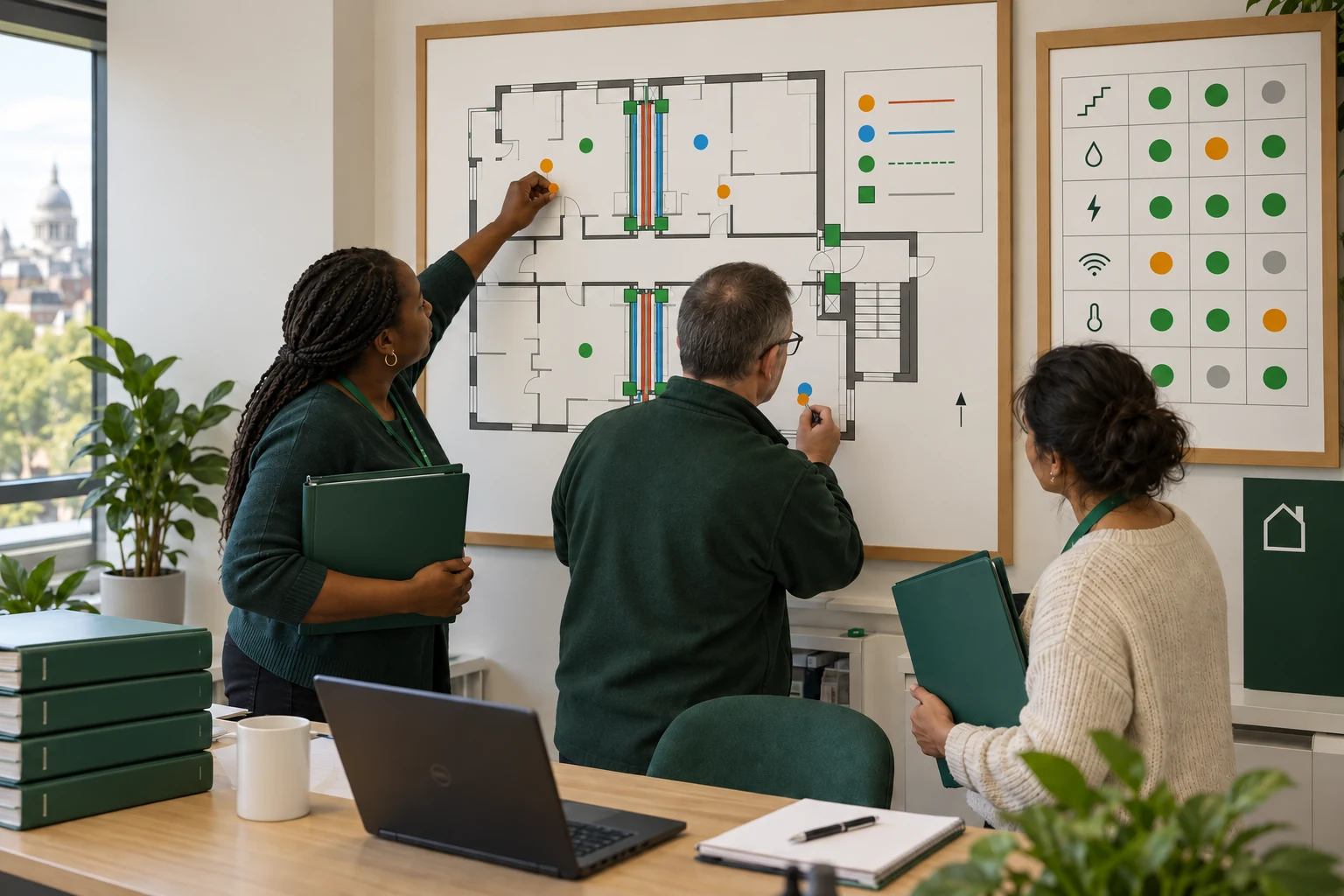
Manage neighbouring-flat reports as one location map with separate household records. Compare dates, rooms and shared services, then arrange permissions and access without declaring which resident or flat caused the problem.
Build the vertical and horizontal map
For each flat, record the exact room, wall, cupboard or ceiling and whether the evidence is sound, sighting, gnawing or droppings. Add service risers, pipe boxes, ducts, corridors, bin areas and voids that cross boundaries. Keep uninspected flats marked unknown rather than clear.
BPCA guidance describes monitoring as a way for professionals to confirm mouse entry points and movement. That supports a coordinated assessment, but it does not prove a route merely because signs align on a plan.
Use one coordinator to contact residents, collect access needs and issue consistent preparation. Share only the information required for inspection and safety. A resident can be told that a shared service route needs access without receiving a neighbour’s private report.
Reports should remain attributable to locations without becoming public accusations. Give each flat a case reference, preserve the resident’s own wording and mark which details were observed by the technician. When two accounts conflict, keep both dates and descriptions rather than choosing the more confident speaker.
Separate access, treatment and repair
Confirm notice or consent through the property’s actual management process. Record locked areas, missed appointments and alternative dates neutrally. Do not ask the pest contractor to decide tenancy rights or liability.
Treatment may need flat-specific instructions; proofing may belong to a communal building repair. Give every repair an exact location, competent trade, target date and verification. Avoid sealing a shared route until activity and timing have been assessed.
For example, kitchen signs in one flat and ceiling noise directly below another may justify inspection of the connecting riser. They do not prove that either resident introduced rodents.
If one resident cannot provide access, continue the safe work that remains possible and state the limitation. Record contact attempts and the next authorised route. Do not describe the whole stack as inspected, and do not use a missed appointment to infer where rodents originated.
Call The City Pest Company on 0203 393 2338 with the location map and access contacts. See pest control for landlords and agents for context.
FAQs
Must every neighbouring flat be treated?
No. Inspection evidence and route assessment should determine scope.
Can one resident’s report be shared with another?
Share only what is needed for coordinated access and action, following the management process.
Who repairs a communal riser?
Use the property’s maintenance responsibility and competent trade; the pest report should identify the route, not decide liability.
Sources and further reading
External references may contain pest or skin photographs.