
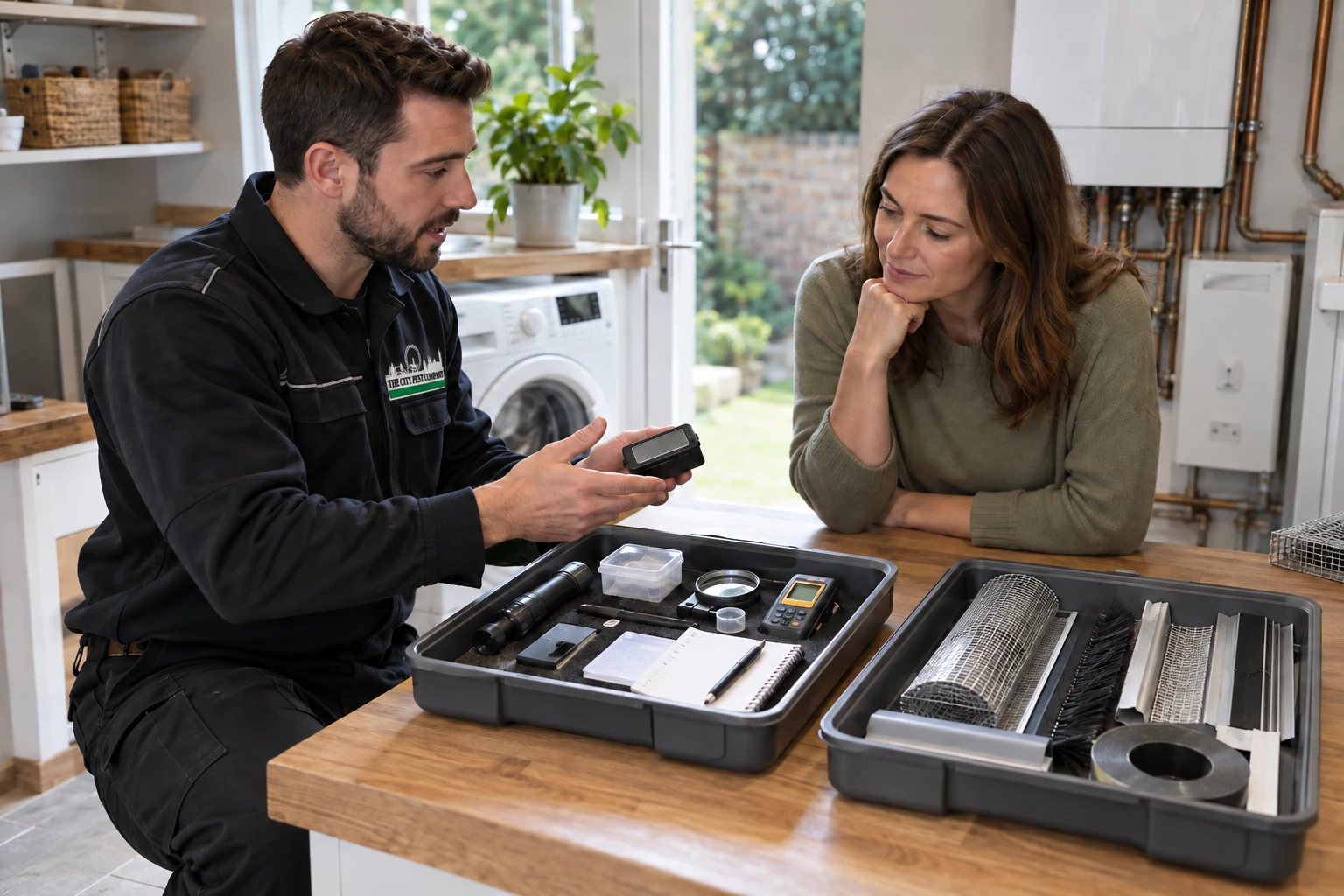
Treatment addresses current rat activity; proofing addresses routes that may allow access. A sound plan connects the two but does not confuse them. Before sealing an opening, ask where it leads and whether closure should be coordinated with control or monitoring. Control without repairing a relevant route also leaves a separate building issue unresolved.
Investigation comes first
Describe sightings, sounds, damage, droppings or smear marks and their location. Note gardens, waste areas, drains, basements, kitchens, service cupboards and roof voids only where they can be observed safely. Do not handle suspected droppings or enter an unsafe space.
An inspection considers whether the evidence is consistent with rats, how the property connects to outside or shared routes, and which areas could not be reached. Noise alone may come from mice, squirrels, birds, pipes or building movement.
What treatment means
Treatment is the agreed response to active evidence. The method depends on the setting, access, people and animals using it, and what is legally and practically suitable. It may include monitoring, trapping or an authorised biocidal product; the appropriate method must be selected after assessing the property.
If a biocide is proposed, the Health and Safety Executive says it must be authorised or otherwise permitted for its use and applied according to the label. Professional-only products are not for household use. Ask where equipment will be placed, how it is protected, who checks it and what happens if it is disturbed.
Treatment also needs a follow-up decision: what evidence is being monitored, when it will be reviewed and what causes the plan to change. Do not accept an unexplained product placement as a complete strategy.
What proofing means
Proofing closes or protects an identified route with a suitable material while preserving the function of the building. Examples can involve damaged doors, holes around services, vents, drains, walls, eaves or gaps created by disrepair, but the remedy depends on the construction.
The person recommending proofing should record the exact feature and distinguish pest work from repairs for a plumber, drainage specialist, roofer, electrician or builder. Fire stopping, ventilation, damp control and service access must not be compromised.
Timing matters. Ask whether the opening is active, what lies beyond it and whether control or monitoring should come first.
Why quotations separate the two
A treatment quote should state visits, monitoring, method and follow-up. A proofing quote should state openings, materials, access, exclusions and whether making good is included. Larger repairs may need a survey and separate estimate.
This separation makes cost and responsibility clearer. It also avoids calling a temporary cover a permanent repair or implying that control equipment repairs the building.
Housekeeping supports both jobs
Secure food, repair leaking water sources where appropriate, keep bins closed and avoid leaving loose waste beside them. Clear only enough clutter for safe access, following professional advice. These steps reduce food and shelter but do not replace investigation or prove who caused the concern.
For shared drains, voids or communal waste, involve the relevant manager. A route may extend beyond the room where the first sign appeared.
Ask for a joined-up record
The final record should show current evidence, actions taken, equipment or restrictions, recommended proofing, other trades required and the next review. After repair, verify the agreed feature rather than assuming every possible route has been closed.
Read the rat service guide or call 0203 393 2338. Mention children, pets, building access and any previous products at the start.
Review the two workstreams together
At each follow-up, compare the activity record with the repair record. A reduction in signs can inform the timing of exclusion, while an unfinished repair can explain why monitoring still matters. If a recommended opening cannot be reached, keep that limitation visible instead of describing the property as fully proofed.
Ask for the next decision in plain language: continue monitoring, change the control plan, complete a named repair or inspect another connected area. This keeps treatment and proofing coordinated while preserving their different scopes, costs and completion evidence.
Common questions
Can I block a rat hole as soon as I see it?
Ask for assessment first. The route, timing and building function all matter, and the professional should explain how closure fits with the control plan.
Does treatment include proofing?
Only if the written quote says so. Ask which openings and materials are included and which repairs need another contractor.
Does proofing guarantee rats will never return?
No universal guarantee is made. The agreed work covers identified features; buildings and surrounding conditions can change.
Sources and further reading
External references may contain pest or skin photographs.